The Price of a Breath: Why Little Raju Had to Die Waiting
Location
Rampur
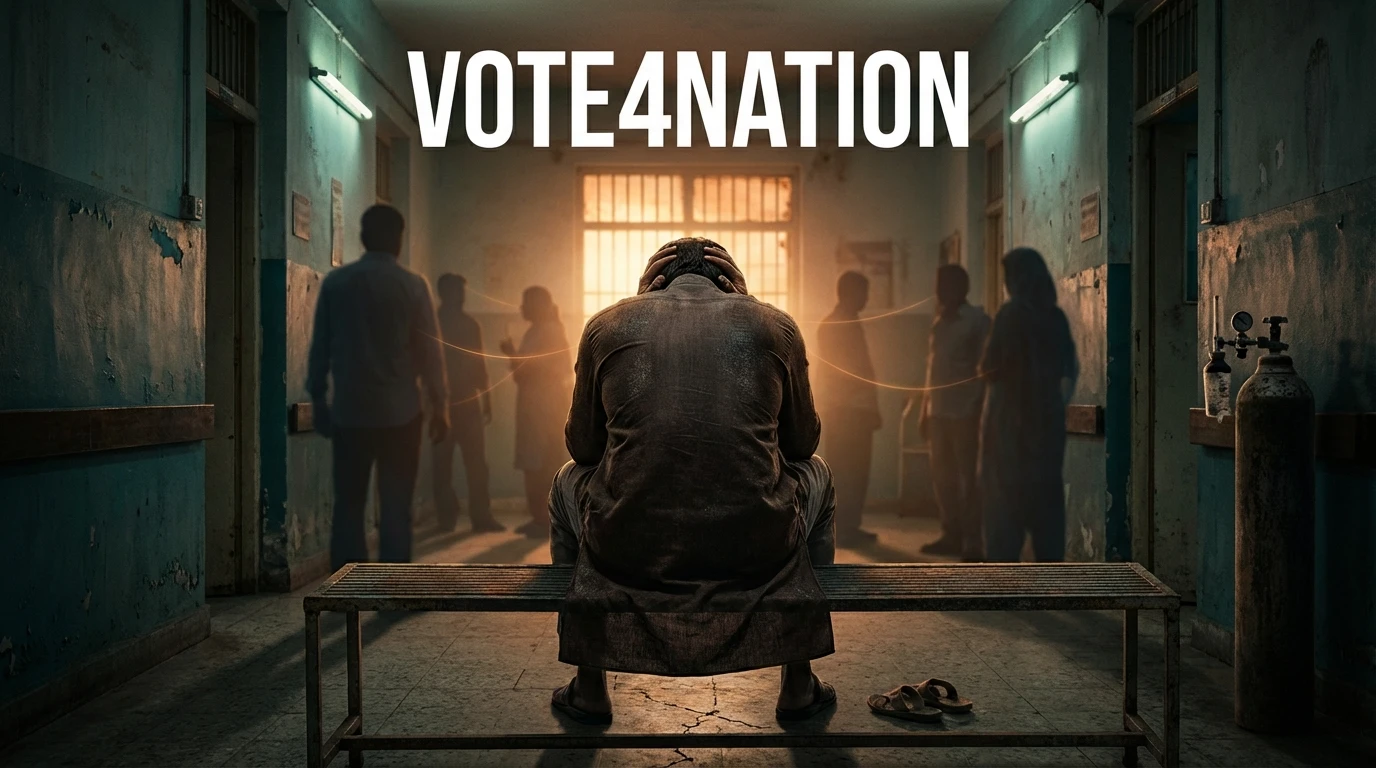
A poor father tries to save his son who is dying of pneumonia. The government hospital denies care due to budget cuts on equipment repair. The private hospital denies admission due to lack of deposit money. The child dies.
The Price of a Breath: Why Little Raju Had to Die Waiting
A Father's Race Against Time
It was a dark, rainy night in the district of Rampur. The roads were full of mud. The streetlights were not working. In this darkness, a man named Ramu was running. He was running fast. In his arms, he held his 6-year-old son, Raju. Raju was small. Raju was weak. And tonight, Raju could not breathe properly.
Raju’s chest was moving up and down very fast. He was making a whistling sound. It was scary. Ramu is a daily wage laborer. He carries bricks for a living. He earns 400 rupees a day. Tonight, he felt like the poorest man in the world. He had money in his pocket, but he knew it was not enough. He was running towards the Government District Hospital.
"Baba, it hurts," Raju whispered. His voice was very low. "I cannot get air."
Ramu cried as he ran. "Hold on, my son. We are almost there. The big doctors are there. They have machines. They will give you air."
The Gate of Hope and Despair
They reached the hospital. It is a big white building. The paint is peeling off the walls. There were many people outside. Some were sleeping on the floor. Some were crying. The smell was bad. It smelled of medicine and old toilets. But Ramu did not care. He ran to the Emergency Ward.
The guard stopped him.
"Stop! Where are you going?" the guard shouted. He was chewing tobacco.
"My son is dying! Please! He cannot breathe!" Ramu begged.
The guard looked at Ramu’s dirty clothes. He looked at his muddy feet. He did not move. "Fill the form first. Stand in the line."
There was a long line. Ramu looked at Raju. The boy’s eyes were rolling back. Ramu fell to the guard's feet. "Sir, please. He will die in the line. Let me see the doctor."
The guard spat on the ground. He looked around. "Give me 50 rupees for tea, and I will let you go inside."
Ramu gave the money. His hands were shaking. This was the first cost of his son's life. It was not the last.
The Cold Room with No Machines
Doctor Verma's Sadness
Inside, it was chaos. Nurses were running. Babies were crying. Ramu found a doctor. Dr. Verma was young. He looked very tired. He had dark circles under his eyes.
Dr. Verma looked at Raju. He used his stethoscope. He listened to the chest. His face became serious. He looked at Ramu.
"His lungs are full of fluid. It is severe pneumonia. He needs oxygen immediately. He needs a Ventilator," Dr. Verma said fast.
"Do it, Sir! Please do it! Save him!" Ramu folded his hands.
Dr. Verma looked down. He looked at the floor. He did not look at Ramu.
"I want to help. But we have a problem. The Ventilator unit is closed."
Ramu stopped breathing for a second. "Closed? This is a big hospital. How can it be closed?"
"The government cut the budget for maintenance last month," Dr. Verma said quietly. "The machine had a small part broken. We asked for money to fix it. The department said there are no funds. They said we must wait for the new financial year. We have three machines. All three are waiting for repairs."
The Cruel Choice
Ramu grabbed the doctor's coat. "So? What happens to my son? You will let him die because of a machine part?"
"You have to take him to a private hospital. City Care Hospital is 5 kilometers away. Go there. Now. Do not waste time."
Private hospital. The words hit Ramu like a stone. Private hospitals ask for thousands of rupees just to enter. Ramu had 2000 rupees in his pocket. That was his life savings.
"I have no money, Doctor! I am a poor man. This is a government hospital. It is free. You have to save him here! Give him oxygen at least!"
"We are out of oxygen cylinders in this ward," the doctor said. He looked angry, but not at Ramu. He was angry at the system. "The supply truck did not come because the contractor was not paid. The bill is pending."
The Business of Dying
Running for Life
Ramu picked up Raju again. The boy was heavy now. He was not moving much. His body was burning hot. Ramu ran out of the government hospital. The rain was heavier now.
He found an auto-rickshaw. "City Care Hospital! Fast!"
The driver saw the emergency. He drove fast. But the roads were full of potholes. Every time the auto hit a bump, Raju groaned in pain.
They reached the shiny glass building of City Care Hospital. It looked like a hotel. There was AC air coming out of the door. It was clean. It was quiet.
The Deposit First Policy
Ramu ran to the reception desk. A lady in a clean uniform sat there. She was typing on a computer.
"Please! My son! He needs a machine! He cannot breathe!" Ramu shouted.
The lady looked at the dirty bundle in Ramu’s arms. She stood up. "Emergency!" she called a ward boy.
They put Raju on a stretcher. They started to wheel him away. Ramu felt hope. Maybe money did not matter. Maybe they would save him.
Then, a man in a tie came out. He was the Manager.
"Stop," the Manager said. The stretcher stopped.
He looked at Ramu. "Sir, you need to pay the admission deposit first."
"I will pay! I will pay everything! Just start the treatment!" Ramu cried.
"The deposit is 20,000 rupees," the Manager said calmly. "ICU charges are separate. We need cash or card now."
20,000 rupees.
Ramu felt the ground spin. "I have 2,000. Take it. Take my watch. I will sign a paper. I will work for you. I will sell my house in the village. Please, start the oxygen. He is turning blue!"
"Policy is policy," the Manager said cold-heartedly. "We cannot admit critical patients without deposit. If he dies, who will pay the bill?"
The Final Breath
Ramu fell to his knees. He touched the Manager's shoes. He put his forehead on the shiny floor. "He is a child. He is just a baby. Do not kill him for money."
The Manager signaled the security guard. "Take him outside. He is creating a scene."
The guard pulled Ramu up. The stretcher was still there. Raju was on it. Raju opened his eyes one last time. He looked at his father. He tried to say 'Baba'. But no sound came out. His chest rose up high, and then it fell.
It did not rise again.
There was silence in the AC lobby. The only sound was the humming of the computer. Raju was gone.
The Investigation: Where Did the Money Go?
The Excuse
Ramu took his son’s body back home in the rain. He did not cry anymore. He was broken.
But VOTE4NATION investigated why this happened. We went back to the Government Hospital. We asked why the Ventilator was broken. We asked why there was no oxygen.
The Hospital Superintendent gave us a letter. It was an official notice. It said:
"Due to reallocation of funds for the upcoming State Summit beautification project, the healthcare maintenance budget is paused for 3 months."
Read that again.
The government took the money meant for fixing breathing machines. They used it to paint walls and plant flowers for a political meeting. They wanted the city to look pretty for the ministers. To make the city look pretty, they let the machines break.
The Reality of Healthcare Cuts
This is not just about Raju. In the last year, budget cuts in this district have caused:
- 15 deaths due to lack of oxygen.
- 40% of staff positions are empty because there is no money for salaries.
- No medicines in the free pharmacy for 2 months.
The rich people go to private hospitals. But even there, if you do not have cash instantly, you are treated like garbage. The poor have nowhere to go. The government hospitals are being starved of money. The leaders say they are "saving money" or "cutting costs." But they are not cutting costs. They are cutting lives.
Conclusion
Raju died because a machine part costing 5,000 rupees was not bought. He died because a deposit of 20,000 rupees was more important than a beating heart. Ramu sits in his hut today. He looks at his son's school bag. He waits for justice. But justice is expensive. And Ramu is poor.
We must ask: How many more children must die before the budget is given back to the hospitals?
Story from real incident happened in India.
Produced by: VOTE4NATION Investigative Team