Choking Dreams: A Father’s Fight Against Delhi’s Toxic Air
Location
Delhi
Department
Pollution Control Board / Ministry of Health
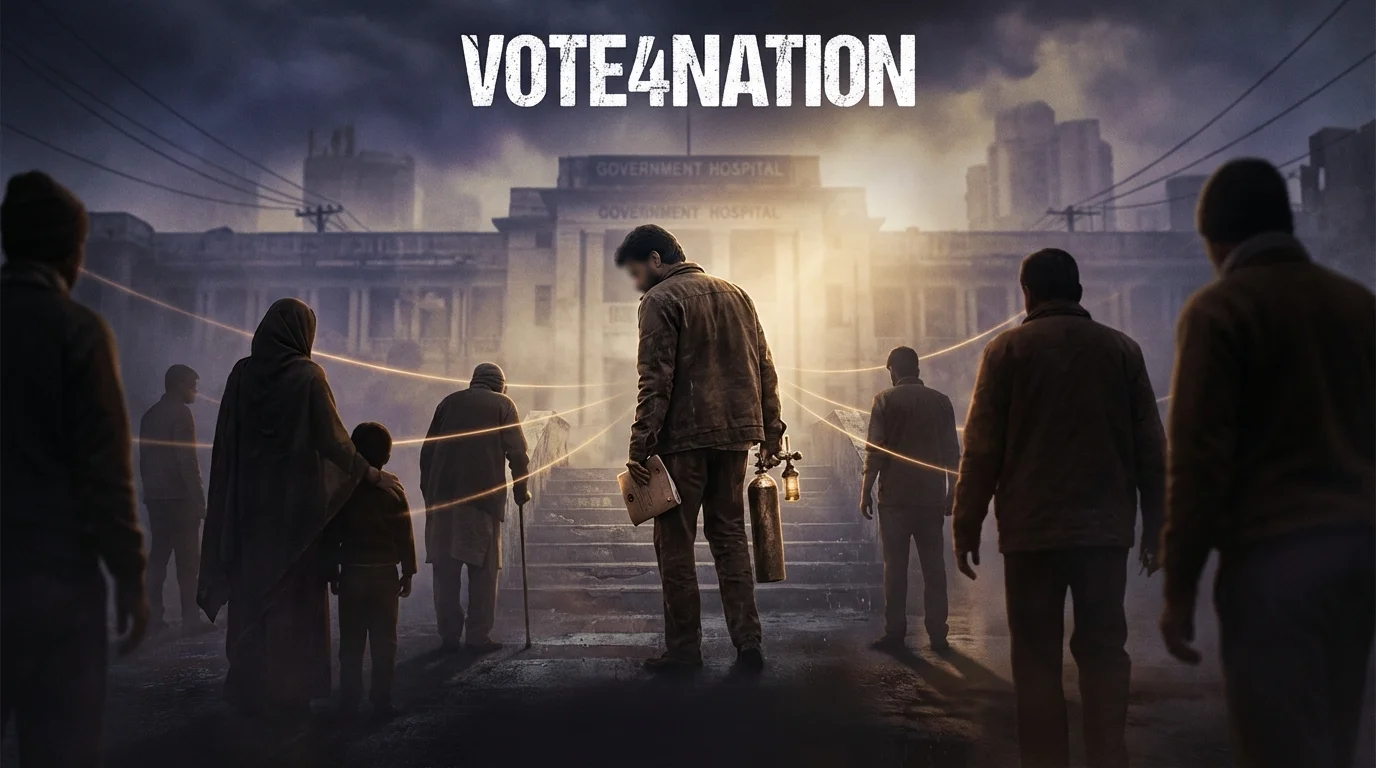
Severe pollution and cold weather in Delhi have triggered a health emergency. Hospitals are overwhelmed with children suffering from respiratory failure. A father struggles to get oxygen for his son in an overcrowded, under-equipped government hospital.
The Black Sky
It was 2:00 AM. The night in Delhi was not dark. It was gray. A thick, heavy blanket covered the city. It smelled like burning plastic and old dust. This is the air that kills silently.
Ramesh sat on the cold pavement outside the big government hospital. He pulled the thin wool blanket tighter around his son, Chotu. Chotu is only six years old. But tonight, he sounded like an old man. His chest rattled every time he took a breath. It was a wheezing sound. A whistle of air trying to pass through a blocked pipe.
"Papa, my chest hurts," Chotu whispered. His voice was weak.
Ramesh held him close. He tried to warm the boy with his own body heat. But Ramesh was cold too. He wore only a torn sweater and slippers. The winter wind mixed with the smog cut through his clothes like a knife.
The Air Quality Index (AQI) was 450 that night. That means the air was poison. For a rich man in a big car with an air purifier, it was just "fog." For Ramesh, a daily wage laborer, it was a death sentence.
The Long Wait
They had been waiting for four hours. The line for the emergency ward was long. It stretched out of the glass doors and onto the road. There were hundreds of people. Mothers holding babies. Old men coughing blood. Young workers who collapsed at construction sites.
Ramesh looked at the glass doors. Inside, it was warm. Inside, there were doctors. But standing between him and the door was a security guard with a stick.
"Get back! Get back in line! No pushing!" the guard shouted. He did not look at the sick children. He only looked at the line.
Ramesh felt anger rise in his throat. He wanted to scream. He wanted to break the glass. But he was a poor man. In this city, a poor man's anger is considered a crime. So, he swallowed his anger and looked down at Chotu.
A System That Failed
Why was the line so long? Because half the doctors were not there. Because the nebulizer machines were broken. Because the city has millions of people, but only a few good hospitals for the poor.
A woman standing next to Ramesh was crying. Her baby was silent. Too silent.
"He stopped coughing," she told Ramesh, fear in her eyes. "Is that good? Or is that bad?"
Ramesh did not know what to say. He just rubbed Chotu’s back. Every cough from his son felt like a hammer hitting Ramesh’s heart.
Inside the Chaos
Finally, at 4:30 AM, they got inside. The smell changed. Outside, it smelled of smoke. Inside, it smelled of disinfectant and sweat. The floor was crowded. People were sleeping on the tiles. There were no beds left.
Ramesh carried Chotu to a desk. A young doctor sat there. He looked exhausted. His eyes were red. He had seen too many patients tonight.
"Name?" the doctor asked without looking up.
"Chotu. He cannot breathe, sahib," Ramesh said.
The doctor put a stethoscope on Chotu’s chest. He listened for three seconds. Then he sighed. He looked at Ramesh.
"It is the pollution. And the cold. His lungs are swollen. Everyone has the same thing tonight," the doctor said.
"Everyone" meant thousands of children.
The Missing Medicine
The doctor wrote on a piece of paper. "He needs a nebulizer. Steam with medicine. Go to room 14."
Ramesh ran to room 14. He carried Chotu in his arms. But room 14 was a war zone. There were three machines. And there were fifty children waiting.
One machine was broken. It sat there, useless, covered in dust. The other two were working, but there were no masks. Parents were sharing masks. One child finished, and the mother wiped the mask with her sari and gave it to the next child. This is how infections spread. But nobody cared about germs now. They only cared about air.
Ramesh waited. Chotu started to shake. His eyes rolled back a little.
"Papa..." Chotu gasped. He could not get the air in.
Ramesh panicked. He looked around. No nurse. No helper. He saw a man finishing with the machine. Ramesh rushed forward.
"Please, brother. My son is dying. Give me the mask," Ramesh begged.
The man looked at Chotu’s blue lips. He nodded and handed over the dirty mask.
The Cost of Breath
Ramesh put the mask on Chotu’s face. The white steam started to flow. Chotu took a deep breath. Then another. His chest stopped shaking. The wheezing sound became softer.
Ramesh closed his eyes and leaned against the wall. Tears rolled down his dusty cheeks. He had saved his son for tonight. But what about tomorrow?
He looked out the window. The sun was trying to rise. But it could not break through the smog. The sky was still gray. The air was still poison.
The Reality Check
Ramesh thought about his work. He works at a construction site. The dust there is bad. Then he goes home to a slum where people burn wood to stay warm. The smoke there is bad. Then he comes to the hospital, and the system is bad.
Who is responsible?
- The government that bans firecrackers but ignores industrial smoke?
- The officials who take bribes to let factories run at night?
- The hospitals that do not buy enough machines for the poor?
Ramesh does not know politics. He only knows that his son cannot breathe.
The Doctor's Truth
Later, the young doctor walked by. He saw Ramesh sitting on the floor with Chotu sleeping on his lap. The doctor stopped for a moment.
"Take him home when the sun is up," the doctor said softly. "But keep him inside."
Ramesh laughed a sad laugh. "Inside where, sahib? My house has a tin roof. The wind comes in through the holes. There is no 'inside' for us."
The doctor looked away. He knew the truth. He knew that this medicine was just a bandage. The real disease was the city itself.
Conclusion: A Gas Chamber
This is not just a story about a cold winter. This is a crime scene. The victims are the children of the poor. The weapon is the air. And the killers are walking free.
As you read this, thousands of fathers like Ramesh are standing in lines. They are holding their children. They are looking at the sky and praying for wind. Because in this country, the poor cannot rely on the system. They can only rely on the wind.
We need answers. We need clean air. Not just for the rich in their towers, but for Chotu on the hospital floor.
Story from real incident happened in India.
Produced by: VOTE4NATION Investigative Team